Field Service Software That Works With QuickBooks: A Methodology-First Comparison
.webp?tr=f-auto,q-80,w-1200,pr-true)
The conventional advice is to choose from a ranked top-ten list of QuickBooks-compatible field service platforms. For almost every field service shop with 5-20 techs that we speak to, that approach misses the mark. The best field service software that works with QuickBooks is not necessarily the most established brand. It's the one that aligns with how your business actually manages work from scheduling to invoicing and fits the QuickBooks version you use for accounting.
This piece works backwards. We'll first identify the criteria used to determine the best fit, then show how the major vendors measure up against those criteria. Field Promax is one of the vendors we'll discuss, and we'll give it the same amount of coverage as the other platforms, including an honest assessment of its pros and cons.
1. Five criteria that decide QuickBooks-FSM fit.
Across owner conversations on Reddit and Quora over the past 12 months, the most frequently reported QuickBooks problem isn't choosing software. In our experience, it's the recurring sync errors and company-file lockouts that pull owners off the truck for half a day. This is the level of volatility your FSM integration is built on top of.
The five criteria we evaluate against:
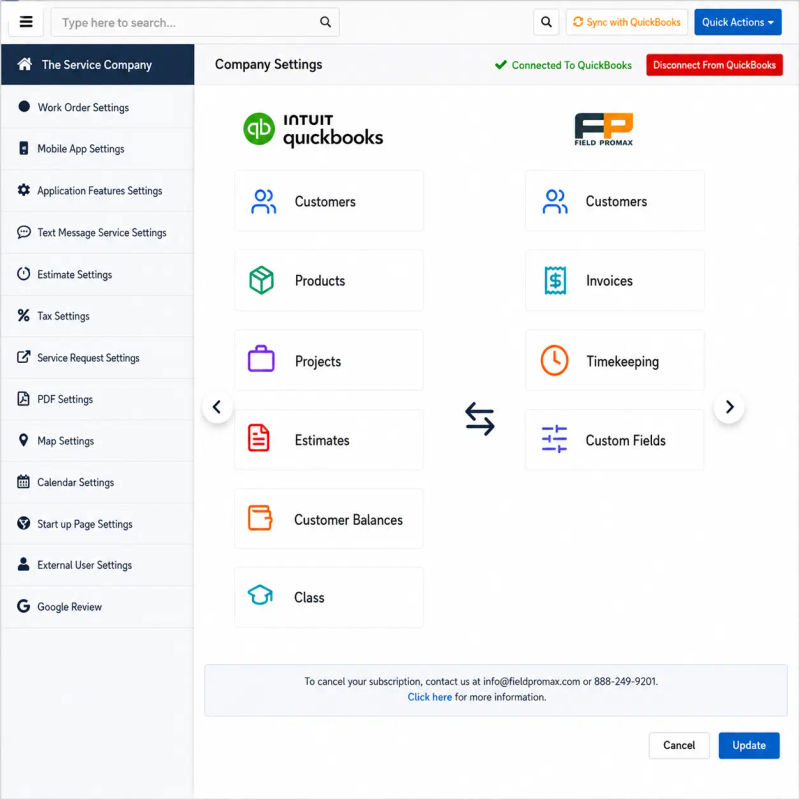
Sync direction (one-way vs two-way). One-way integrations push data from your FSM to QuickBooks only. Two-way integrations allow changes to flow between both systems. If your bookkeeper updates a customer's address in QuickBooks while your FSM uses a one-way integration, dispatch may still send techs to the old address. Do you recognize the pattern? Problems like this are often more expensive than a failed sync because they create operational errors in the field.
QuickBooks Desktop vs Online coverage. Per Intuit's official announcement, new U.S. subscriptions for QuickBooks Desktop Pro Plus and Premier Plus ended September 30, 2024, with Enterprise unaffected. In our customer base, plenty of 5-20 tech multi-trade shops still run Desktop or Enterprise on purpose, so the vendor has to cover both, or the QuickBooks side of the migration becomes its own project.
Pricing fit for the 5-20 tech band. Per-user pricing that seems reasonable at 3 techs can become expensive at 12. Whether a vendor uses tiered or flat-rate pricing can tell you a lot about whether it's designed for your needs.
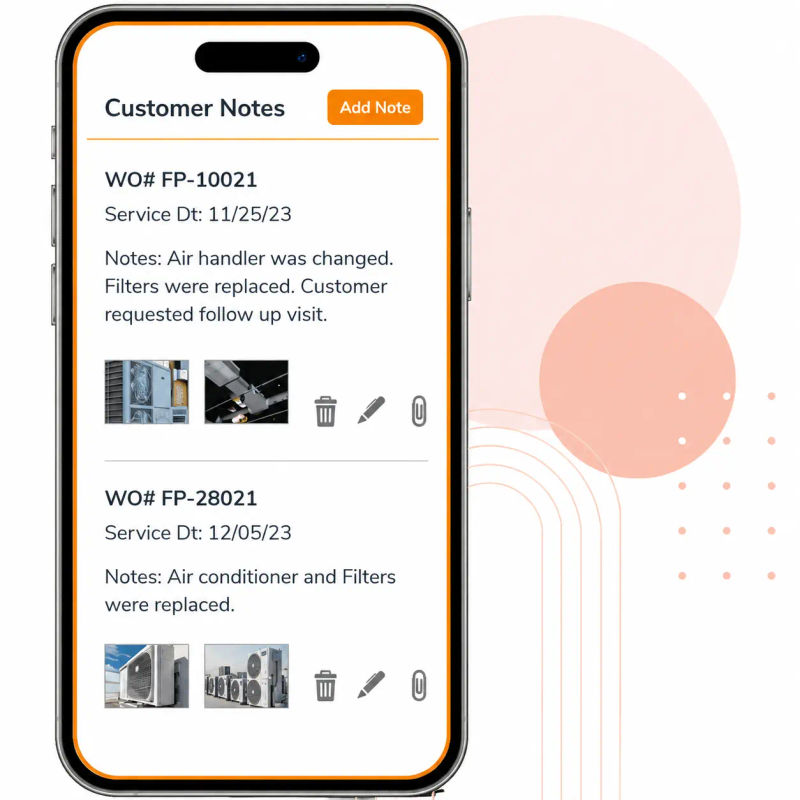
Mobile-app quality. Mobile-app adoption by techs is the single biggest predictor of whether a rollout works. The sync only fires when the tech hits send on the field service invoice. If the mobile app is clunky, techs don't close jobs in it, and the QuickBooks sync becomes a back-office re-keying problem in a new wrapper. You didn't buy software to create a different data entry job.
Implementation support depth. Chart of accounts mapping, sales tax item mapping, and customer list de-duplication are not tasks that can be completed with a single click. The quality of a vendor's onboarding process matters more than what's written on an implementation specification sheet. A well-written specification is of little value if nobody helps you configure it correctly. You'll notice the difference when month-end closing arrives.
2. What "integrates with QuickBooks" actually means.
Per developer-side analysis of the QuickBooks API, QuickBooks Online supports full CRUD on accounting objects, so true two-way sync is technically possible. Whether a vendor builds it is a product decision. In our experience, the shops that misjudge this assume "integrates with QuickBooks" means the QB customer record is the source of truth, then learn months later that their FSM only pushed invoices in one direction. One-way sync is better than no sync. It is not the same as integration.
The second split is QuickBooks Online vs Desktop. Per published market data, QuickBooks holds roughly 62% of the US small-business accounting software market, with QuickBooks Online revenue reaching about 2.6x Desktop revenue by 2023. From working with shops on both rails, the field service tool has to talk to your exact QuickBooks version or it doesn't get bought, no matter how strong the rest of the feature set is.
The operational delta is what makes the integration worth paying for. Intuit's 2024 Business Solutions Survey reports growing businesses spend roughly 25 hours per week on manual data entry and reconciling data across apps. In our customer base, shops on a live FSM-to-QuickBooks sync claw back a meaningful chunk of those hours and shorten the days-to-invoice gap from a multi-day backlog to next-day in the common case.
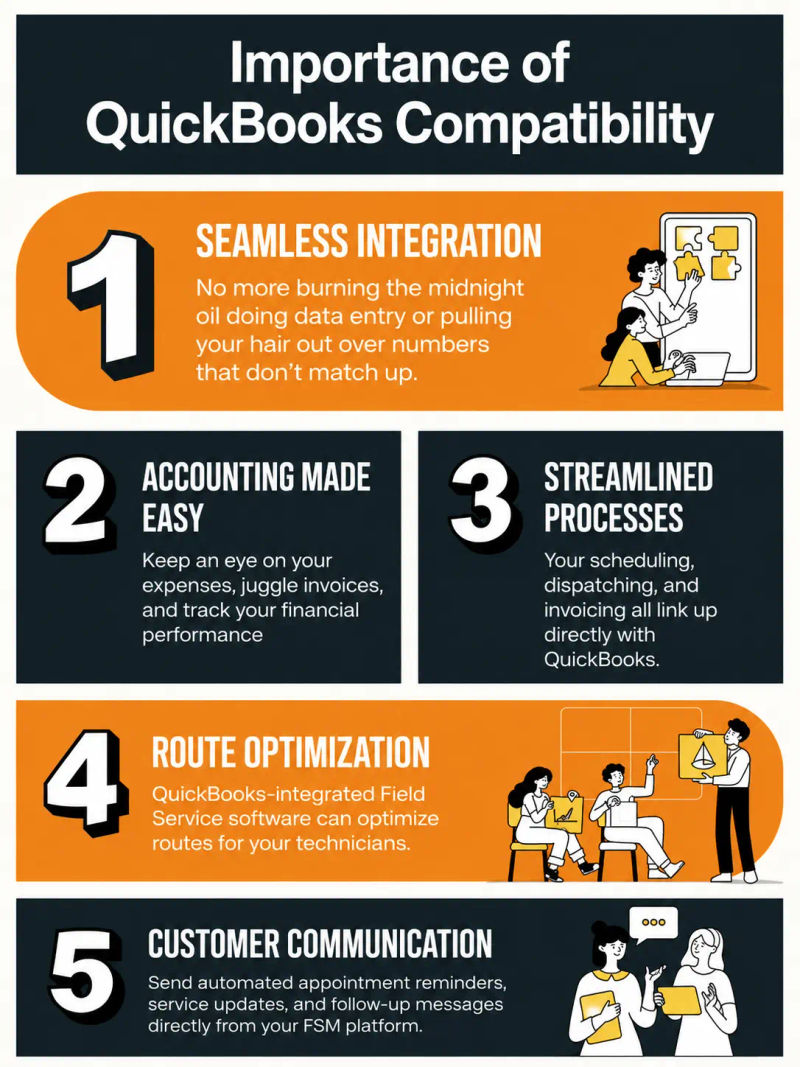
Our STANCE: "Integrates with QuickBooks" is the most abused phrase in FSM marketing. Every vendor puts it on their homepage. Ask specifically: which QB version, which data objects, which direction, and what breaks when Intuit ships an update. The answers will cut your shortlist in half before you watch a single demo.
3. How the major vendors stack up against those criteria.
Pricing and ratings below come from G2 and Capterra (late 2025), vendor sites, and a published FSM comparison analysis. Across our shops, the pattern is that headline pricing rarely predicts total cost. Per-user creep, onboarding hours, and the QuickBooks mapping work matter more than any monthly sticker.
Service Fusion. Native QuickBooks Online and Desktop sync, flat-rate pricing, and strong scheduling capabilities. Cons: The UI feels dated, mobile reviews are mixed, and the customer portal is fairly basic. This is a strong fit for budget-conscious businesses and Desktop-based shops that prioritize functionality over a modern, tech-forward interface.
Residential-focused SMB platforms. Clean mobile apps, well-reviewed onboarding, and QuickBooks Online and Desktop integrations that support a variety of residential service workflows. Cons: Per-user pricing can become expensive beyond five techs, and customization options are limited. This is an ideal fit for shops with fewer than ten techs that primarily focus on residential work.
Enterprise-grade FSM platforms. The most comprehensive accounting layer available, with support for QuickBooks Online, QuickBooks Desktop, and Sage Intacct, along with ERP-style reporting capabilities. Cons: Pricing is geared toward larger organizations, and implementation can take several months, making it difficult to justify for a 10-tech shop. This is the best fit for businesses with 25+ techs working on commercial projects and dedicated operations teams to manage the implementation process.
Jobber. Clean UX, a strong client-facing portal, and a polished mobile app for technicians. The QuickBooks integration is one-way and supports QuickBooks Online only, with no QuickBooks Desktop compatibility. Cons: Per-user pricing becomes expensive beyond three techs, and changes made by bookkeepers in QuickBooks do not automatically sync back to the platform. This is an ideal fit for owner-operators and small shops with 2-5 techs.
Field Promax. Two-way QuickBooks sync covering Online and Desktop, flat pricing tilted toward 5-20 tech shops (Light $99/month, Standard $159/month, Premium $239/month), sync triggered when the tech closes the work order on the mobile app. Cons: enterprise-grade reporting is basic compared to platforms built for 50-plus tech operations, UI polish lags larger general-purpose tools, customer-portal features lighter than mobile-first SMB apps. Fits multi-trade shops migrating off spreadsheets or QuickBooks-only setups.
The older players in this space. These platforms offer QuickBooks Online integrations with varying levels of functionality and generally less support for QuickBooks Desktop. Some are designed for specific verticals, such as landscaping or solo operators, while others target the mid-market and provide more advanced field mapping and customization options. According to Capterra and G2 reviews, overall ratings are positive, but the drawbacks are consistent. Smaller engineering teams can make QuickBooks sync issues more difficult to resolve, and the mobile apps are often less polished than those offered by leading platforms.
The operational case for any integration on this list isn't "we sync data." From years of watching customers wire this up, it's whether the back office stops being a Sunday job.
4. A pattern across small operators we've worked with.
In small companies we've worked with since 2019, the same pattern appears repeatedly. Consider an owner-operator running a small mixed-trade field service shop with fewer than 10 technicians in a storm-prone region. When a storm takes trucks off the road for up to three days, the dispatcher often ends up triaging the rebooking queue based on which customer complains the loudest because there is no formal system for determining who should be rescheduled first.
In one case, a weather incident took two trucks and wiped out three days of scheduled work. The dispatcher rescheduled customers as complaints came in. Maintenance-contract customers continued to be pushed back by one-time callers who were more vocal, and the owner had no objective way to justify the order of rescheduling.
The following month, the owner created a one-page incident playbook that ranked jobs by urgency level and contract status, then walked through the process with the dispatcher using a tablet and the previous week's disrupted schedule as a real-world example. The first draft didn't work perfectly. The team revised it and walked through the exercise two more times until the dispatcher stopped second-guessing priority decisions in the middle of a shift.
The next disruption ran with roughly half the chaos. The friction came from an elderly residential customer on no service contract whose situation clearly outranked the playbook's logic - one escalated complaint forced a revision adding a vulnerability flag. The dispatcher adopted it quickly; the part-time after-hours answerer was the holdout. This is a composite drawn from the most common version of the pattern, and the same disruption is where one-way QuickBooks sync quietly hurts: every reschedule and re-invoice has to flow back to accounting, or the back office spends the following week reconciling jobs that moved.
5. CEO note on what actually predicts a successful integration.
The conventional wisdom is that "QuickBooks integration" is a feature checkbox you tick during evaluation. I disagree. From years of customer conversations across our base, the shops where the integration actually pays off treat it as a workflow contract, not a software feature. The contract is simple: the tech closes the work order on the mobile app, and the invoice posts to QuickBooks the same minute. Everything else - the dispatch logic, the customer record, the sales-tax mapping - exists to support that single handoff happening cleanly thousands of times a year.
Most QuickBooks-compatible FSM comparisons rank platforms on feature counts and integration spec sheets. That gets the question backwards. The single biggest predictor of whether the integration works isn't sync depth or API completeness - it's whether the techs actually adopt the mobile app. If they won't close jobs in the app, the sync never fires, and the back office is re-keying invoices on a weekend no matter how impressive the integration looked in the demo.
- Joy Gomez, Founder of Field Promax
6. How to choose your shop.
Decision shortcuts that hold up in our customer base:
Under 5 techs, QuickBooks Online, residential. Polished SMB-focused platforms such as Jobber are reasonable starting points. However, the cost per user rises as you grow, and one-way sync can become a problem once your bookkeeper starts making changes in QuickBooks that need to flow back into the dispatch system.
5-20 techs, multi-trade, QuickBooks Desktop or Enterprise. Field Promax and other mid-market platforms with two-way sync are worth comparing. The key differentiators are the depth of the sync in both directions, Desktop support that won't break when Intuit releases the next update, and onboarding that carefully maps your chart of accounts.
25-plus techs, commercial work, ERP-grade reporting. Enterprise-tier FSM platforms designed for large commercial fleets may be the better fit, despite their higher cost.
Verticals shape the choice too. For HVAC shops running seasonal maintenance contracts, QuickBooks customer-record fidelity matters more than mobile polish. For plumbing and electrical shops doing one-off residential work, invoice-posting speed beats reporting depth. For pest control and landscaping running recurring routes, the FSM has to treat recurring billing as a first-class concept.
The implementation question that determines a project's success isn't "does it sync?" It's about whether chart-of-accounts mapping, sales tax item mapping, and customer-list de-duplication are handled by someone who has been through the process before. Our experience has shown that manually entered invoice runs introduce enough small errors such as incorrect totals, mismatched job costs, or missing line items-that month-end reconciliation can turn into a hunt. Automated syncs wired to the work-order closure event eliminate most of this friction, while the remainder of the process is reduced to handling exceptions.
The job costing argument: why invoice sync alone isn't enough
The majority of trade business owners purchase FSM software to avoid chasing paperwork. However, the operators who gain the most value from a strong QuickBooks integration use it for something more substantial: job costing.
Job costing involves tracking every dollar that goes into a job - parts, labor hours, subcontractors, equipment time - and comparing those costs against what you charged the customer. That's how you discover that you've been losing $40 on every HVAC tune-up for the past three years because material costs increased while your flat-rate pricing stayed the same. You won't uncover that with an invoice-only sync.
A proper job-costing process requires expenses, vendor bills, and employee timesheets to flow from the FSM into QuickBooks, not just the final invoice amount. According to a 2024 Software Advice survey, businesses using automated QuickBooks syncs experienced 25% fewer invoice disputes.
The more important benefit is that with accurate job-specific data in QuickBooks you can calculate a profit and loss report by job type and determine which services earn money.
One electrical contractor mentioned in a G2 review that linking the FSM to QuickBooks allowed them to see that commercial service calls cost 30% more than residential calls - data they didn't have access to during the time that jobs and billing were on separate systems.
| Job Costing Element | Data Origin | Syncs to QB? | Required for Full Job P&L |
| Labor hours | FSM time tracking | Depends on tool | Yes |
| Parts / materials | Work order line items | Usually yes | Yes |
| Subcontractor costs | Vendor bills in FSM | Rarely | Yes |
| Invoice amount | Completed work order | Always | Yes |
| Payment received | FSM payment capture | Two-way tools only | Yes |
Six setup mistakes that break the integration before it starts
These are real integration failures, not hypotheticals.
1. Skipping chart-of-accounts mapping. Every invoice that syncs must be assigned to the correct income account. If you don't map your FSM job categories to the appropriate QuickBooks income accounts before the first sync, revenue may be posted to the wrong categories or worse, not recorded correctly at all. Fixing the issue before launch might take 30 minutes. Ignoring it could cost six hours of cleanup at quarter-end.
2. Creating invoices in both systems. Choose one origin (typically your FSM) and let it push invoices into QuickBooks. Do not create the same invoice in both systems. Once duplicate entries and deleted transactions start appearing in QuickBooks, reconciliation can become complicated very quickly.
3. Not testing before going live. Test an invoice through the entire workflow. Create it in the FSM, allow it to sync, verify it in QuickBooks, record a test payment, and confirm that the payment is applied correctly. Identify mapping issues in a sandbox environment, not on a real customer invoice.
4. Ignoring customer name formatting. QuickBooks can be sensitive to customer names. Extra spaces, special characters, or inconsistent naming conventions (for example, "Jones & Sons" versus "Jones and Sons") can cause sync failures or duplicate records. Clean up customer data before connecting the systems.
5. Treating the integration as set-and-forget. QuickBooks updates can interrupt OAuth connections or disconnect the Web Connector. Review integration logs at least once a week, especially during the first two weeks after a software update on either platform.
6. No one owns the integration health check. Someone on your team should be responsible for monitoring sync logs. Without ownership, problems often go unnoticed until an accountant asks why last month's invoices are missing. Assign it before going live.
Regional notes: US and Canada specifics
Sales tax laws in the United States are a patchwork. HVAC parts are taxable in most states, while labor may be taxable in certain states but exempt in others. Texas handles HVAC installation and repair work differently from some other jurisdictions. Colorado has multiple local tax rates within a single metropolitan area. Your FSM should transmit the correct tax rate to QuickBooks on every invoice. If it does not support location-based tax mapping, you'll be left manually adjusting tax rates, which defeats the purpose of automation.
For Canadian operators, QuickBooks Online Canada is a different instance from the U.S. version. Some FSM platforms integrate with U.S. QuickBooks Online only - Verify Canadian support directly rather than assuming it exists. GST/HST mapping should be configured during setup, not assumed. Field Promax supports both the Canadian and U.S. QuickBooks Online environments, offering similar two-way sync functionality on both platforms.
KPI benchmarks: what the integration is actually worth
| KPI | Without Integration | With Integration | Source |
| Hours/week on manual data entry | 15-20 hours | 1-3 hours | Arrivy, 2024 |
| Average payment cycle | 18-25 days | 7-12 days | Fieldy case study, 2024 |
| Invoice error rate | 8-12% | 1-3% | GetApp user reviews, 2024 |
| Invoice dispute rate | Baseline | 25% fewer | Software Advice survey, 2024 |
| Weekly reconciliation time | 4-8 hours | Under 1 hour | G2 reviewer data, aggregated |
Year-by-year: FSM market growth
| Year | FSM Market Size (Global) | Key Driver | Source |
| 2022 | $4.43B | Post-pandemic field ops recovery | Grand View Research |
| 2023 | ~$4.80B (est.) | Cloud migration acceleration | GVR est. |
| 2024 | ~$5.00B (est.) | SMB digital adoption | Multiple sources |
| 2025 | $5.10B | AI dispatch and mobile-first tools | MarketsandMarkets |
| 2026 | $5.88B (projected) | Workflow automation demand | The Business Research Co. |
| 2030 | $9.17B (projected) | IoT, predictive maintenance, AI | MarketsandMarkets |
Sources consulted
- Intuit, QuickBooks Desktop stop-sell FAQ
- Intuit, 2024 Business Solutions Survey
- Merge.dev, QuickBooks API capability analysis
- Electro IQ, QuickBooks market share and revenue statistics
- G2 and Capterra vendor profile pages for ratings (accessed late 2025)
- Owner discussions on r/HVAC, r/Plumbing, and Quora trade contractor threads (12-month window)
Conclusion
Select the integration that best matches how your shop operates and how jobs move from booking to invoicing, depending on the QuickBooks version you use. Feature checklists rank vendors, but workflow constraints determine which one can survive the first week of storms.
To see how two-way field service software that works with QuickBooks looks wired into a 5-20 tech multi-trade shop, book a demo.
Frequently Asked Questions

Content Creator
Bhargavi Halthore is a content writer at Field Promax, a field service management platform serving trades businesses across the USA and Canada. With over a decade of experience writing for business owners, she brings detailed, ground-level insight to every topic she covers. Her research goes beyond search results - she digs into LinkedIn groups, Facebook communities, and Reddit forums to understand what field service business owners are actually dealing with on the ground. She speaks directly with industry professionals, understands their day-to-day challenges, and translates that into content that is practical and actionable. What you read in her articles reflects real industry patterns, not theory.